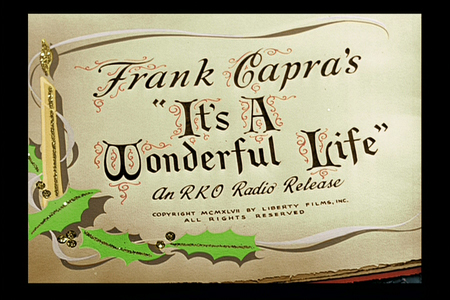
I have been talking about It's a Wonderful Life, the 1946 Frank Capra film, a lot lately.
I generally talk about this movie around this time of year because people are more willing to listen and contribute to a IAWL conversation around the Holidays.
Though I feel this movie is relevant at all times, most feel that it is a Christmas movie.

This year, due to the $700 billion dollar bail out, the recession and the holidays, IAWL has become a staple for economic and societal comparison.
The whole thing pisses me off.
This movie is often considered an uplifting holiday tale. I firmly disagree.
I remember watching a documentary about IAWL and Frank Capra, hosted by his son, Frank Capra Jr.

The documentary noted that the film wasn't an initial success. Often called "Capra-corny" because of it's story line. I have always seen the darker and more realistic, historical even, side of this movie. There are so many human events that occur that the story can be a reflection of anyone's life between childhood and adult hood. Capra covered the ideals of small town life, but mixed them in with the realities of hardship and societal pressures.
He shows that some people live the American dream because someone else makes sacrifices and stays put. He shows the elitism, ageism and pressures that are presented all the time, whether it's in an urban or rural atmosphere.
I often look at Donna Reed's character, Mary. She is my favorite, of course, but she is a harsh look as to what women were to sacrifice, due to the circumstances of nothing more than life.
Mary is a highly educated woman who is in love with a man who wants to see the world. She goes off to college and lives in NYC for holidays, but sees a bigger need in staying home and marrying the man of her dreams, George Baily.

(James Stewart and Donna Reed (as George and Mary) in my favorite scene of the film)
Mary Bailey: "Because I didn't want to be an old maid, I want my baby to look like you" (black and white and to the point!)

Mary as an old maid (librarian... God forbid she use that college education!)
George doesn't understand why she could possibly want him, and sometimes I too question Mary's motives. I think she sees him in his true form, the glue of their world in Bedford Falls.

(The photo from the New York Times. I think it's a cool graphic.)
There was an article in the New York Times today about It's a Wonderful Life. The article, "Wonderful? Sorry, George, It’s a Pitiful, Dreadful Life," by Wendell Jaimeson, was cynical and addressed the darker side of the movie as well as the people who see it now and the way society is reacting to the recent economic downfalls.
The most poignant remark in the article is the following:
Was this what adulthood promised?
“It’s a Wonderful Life” is a terrifying, asphyxiating story about growing up and relinquishing your dreams, of seeing your father driven to the grave before his time, of living among bitter, small-minded people. It is a story of being trapped, of compromising, of watching others move ahead and away, of becoming so filled with rage that you verbally abuse your children, their teacher and your oppressively perfect wife. It is also a nightmare account of an endless home renovation.
This revelation that the author has come upon is close to my worldview of It's A Wonderful Life this year. I'm not quite as cynical as the author, but I have had trouble watching the movie due to it's realizations of dreams NOT coming true.Graduating in this less than perfect economy has put a strain on getting the ball rolling in my career arena. I want to go into film making, but picking up and leaving with student loans catching up with me, the job market rejecting me and not knowing if any grad schools will take me have all proven to keep me in my, to coin a George Bailey phrase, "crumby little old town."
As positive as I try to be, some days are hard. Though I have a job right now, a place to live, food, friends and a supportive family, sometimes I feel like George-- I want to "see the world."

(Me post graduation... yes that is dog food and the Swedish flag... jealous?)
Some of the words George says mine as well be coming straight from my mouth.
" I know what I'm gonna do tomorrow, and the next day, and the next year, and the year after that. I'm shakin' the dust of this crummy little town off my feet and I'm gonna see the world. Italy, Greece, the Parthenon, the Colosseum. Then, I'm comin' back here to go to college and see what they know. And then I'm gonna build things. I'm gonna build airfields, I'm gonna build skyscrapers a hundred stories high, I'm gonna build bridges a mile long..."
The ambitions of George Bailey have yet to be squashed by the constant needs of others and his consistent support of his fellow man. He becomes tired from the world around him; always taking.
Joseph says in the movie "...George never leaves Bedford Falls"
This is a hard pill to swallow for someone who is trying to get out and see what the world has to offer past what they know. George's setbacks and obstacles are hard to view because I am constantly wondering "What if I become like George Bailey?"
My Mother always says "What's so wrong with being George Bailey? You're missing the message."
Well, Mom, I understand he's a good man, and I truly believe in "Deeds not words" but there are many other messages too. Each generation or I should say, each age, has their own interpretation of this movie. The New York Times author, was kinda whiny about his view of the movie. He was pessimistic from the get go. Not really ever wanting to see it, but then finally "getting it." His teacher, who showed him the film after school, was trying to reach out and share a movie that meant something to him.
The teenage angst could totally be felt through this movie. The confusion and aimlessness that occasionally occurs is more than welcomed into everyone's lives.
I think we all like to look back and talk about the economic message in IAWL because it is a pop-icon of what could happen if the little man gave what he's got to keep from a financial depression. It is recognizable and true. Though, GB would not be able to help us out of a billion dollar crisis, he could always lend a quick buck or a hand.
The catch to all of my complaining is that now people are willing to discuss the movie on a different level. The focus on mocking the "corny-ness" or talking about how black and white movies aren't "as real" or "as pertinent to today's world" are all wiped away because they are untrue.
I like to see the goofiness of this movie and the small qualities and quirks that are also true to life's lighter moments. I disagree with the NYTimes author about the movie theatre in the film showing The Bells of St. Mary's as a hokier prop. That movie was popular at that time and it would have been the movie playing in a local cinema. Yes, it's another prayer or religiously touched (or tainted depending on your viewpoint) movie, but it starred Ingrid Bergman and Bing Crosby, who were both at the height of money making careers. The plug was probably WAY less sentimental than that. It was more like a commercial for RKO which produced both films. My Father and I revel in the fact that one of our favorite movies is in another fave... I mean we're nerds... what do you expect?

(see the tiny RKO logo... hint, hint.)
George may have to go to the extremes of looking at suicide as a relief to his problems, but he then sees the dark (kinda ridiculous, yet directly true) side of what "could be" and changes his mind.
I plan on leaving this peninsula, on which for now I am caged, but if I can't... I'll think of George and Mary, Suzu and Clarence... and I won't jump.

(I'm not suicidal... just thought it wraps it up pretty nice-like)


3 comments:
damn, thats a pretty deep look at iawl. There is a dialog when they meet at the dance and the one kid is tell Mary he don't play like that. I love that rip. I want to put it on my cell phone. By the way there is a silver screen version out there all digital and pretty sharp. See if you can find it. Its worth watching. You notice the back drops so much more.
Thanks for the comment.
I own the digitally enhanced 60th anniversary edition. The details are always great.
Thanks for reading!
Dear Ms. Serious,
Nice post! My name is Peter Ricci, and I'm a college student and journalist who currently contributes to 'Too Shy to Stop,' an online magazine focused on culture and the arts.
I came across your post, as it would turn out, while searching for different blogs on "It's a Wonderful Life," as I just finished an essay on the film.
While a wonderful film, I take an alternate view, seeing it as a populist message in cue with Capra's career and its current status as a holiday chestnut a gross misinterpretation.
Check it out! I think you will like it, and I would love a comment: http://tooshytostop.wordpress.com/2008/12/24/its-a-wonderful-life-wonderfully-misinterpreted/
Sincerely,
Peter Ricci
Post a Comment